Can you keep the weight off safely after Mounjaro?
Often, yes, but it takes a plan made before your last injection rather than after it. Mounjaro contains tirzepatide, which suppresses appetite while you are taking it. Once it clears your system, that effect goes with it, and hunger returns. Weight regain is common. It is not inevitable, and it is not a failure of willpower.
The medicine does not leave your body the moment you stop. Tirzepatide clears gradually over the weeks after your final dose, so appetite usually returns over that period rather than overnight. What matters is that you have already decided what you are going to do when it does.
A post hoc analysis of the SURMOUNT-4 trial found that people who regained more weight after stopping also lost more of the improvement they had gained in things like blood pressure and blood glucose. That trial looked at a defined group of adults without diabetes, so it describes a pattern rather than predicting your outcome. It does make the point that what you are maintaining is not only a number on the scales.

Men’s Weight Loss Follow Up – Illustrative Image
What Is In This Article
Why you stop changes how you stop
There is no single route off Mounjaro. What happens next depends on why you are stopping, and some of these are medication safety decisions rather than weight management ones.
| Why treatment is ending | What changes | What your prescriber needs to review |
|---|---|---|
| You have reached your target weight | The work shifts from losing to maintaining | Your progress, your appetite, and what you will both do if weight starts rising again |
| You are planning a pregnancy | Timing becomes the priority | When your last dose needs to be, and how weight is managed in the meantime |
| You had adverse effects | The cause and severity decide whether this is permanent | Whether a restart is appropriate later, and whether a slower dose build-up would help |
| You had confirmed pancreatitis | Tirzepatide is not restarted at all | What else can support your weight management instead |
| You take it for type 2 diabetes | Your glucose control is affected, not just your weight | Your other diabetes medicines, your blood glucose and your HbA1c, the measure of average blood glucose |
NICE, which covers England, advises stopping tirzepatide at least one month before trying to conceive. If you become pregnant while taking it, stop immediately and speak to your prescriber.
We run doctor-led medication and metabolic reviews for exactly this transition, so the plan is agreed before the last injection rather than assembled afterwards.
There is no standard taper, and no safe way to improvise one
Tapering. NICE sets out no routine tapering schedule for coming off tirzepatide. Whether your dose is reduced first, and over what period, is a decision for your prescriber based on why you are stopping and what has happened during treatment. The absence of a standard schedule is not an invitation to design your own.
Dose spacing. Stretching the gap between injections to make a supply last is common and unwise. It changes what you are taking without anyone recording that you have changed it, which makes any later problem harder to interpret.
Leftover injections. Anything left in the fridge stays there until a prescriber has reviewed whether using it is appropriate.
Restarting. If weight comes back, restarting is a fresh clinical decision rather than an automatic one. NICE advises considering more intensive diet and activity support, with or without restarting tirzepatide, after review. Where someone stopped because of adverse effects, a slower build-up may be part of that conversation.

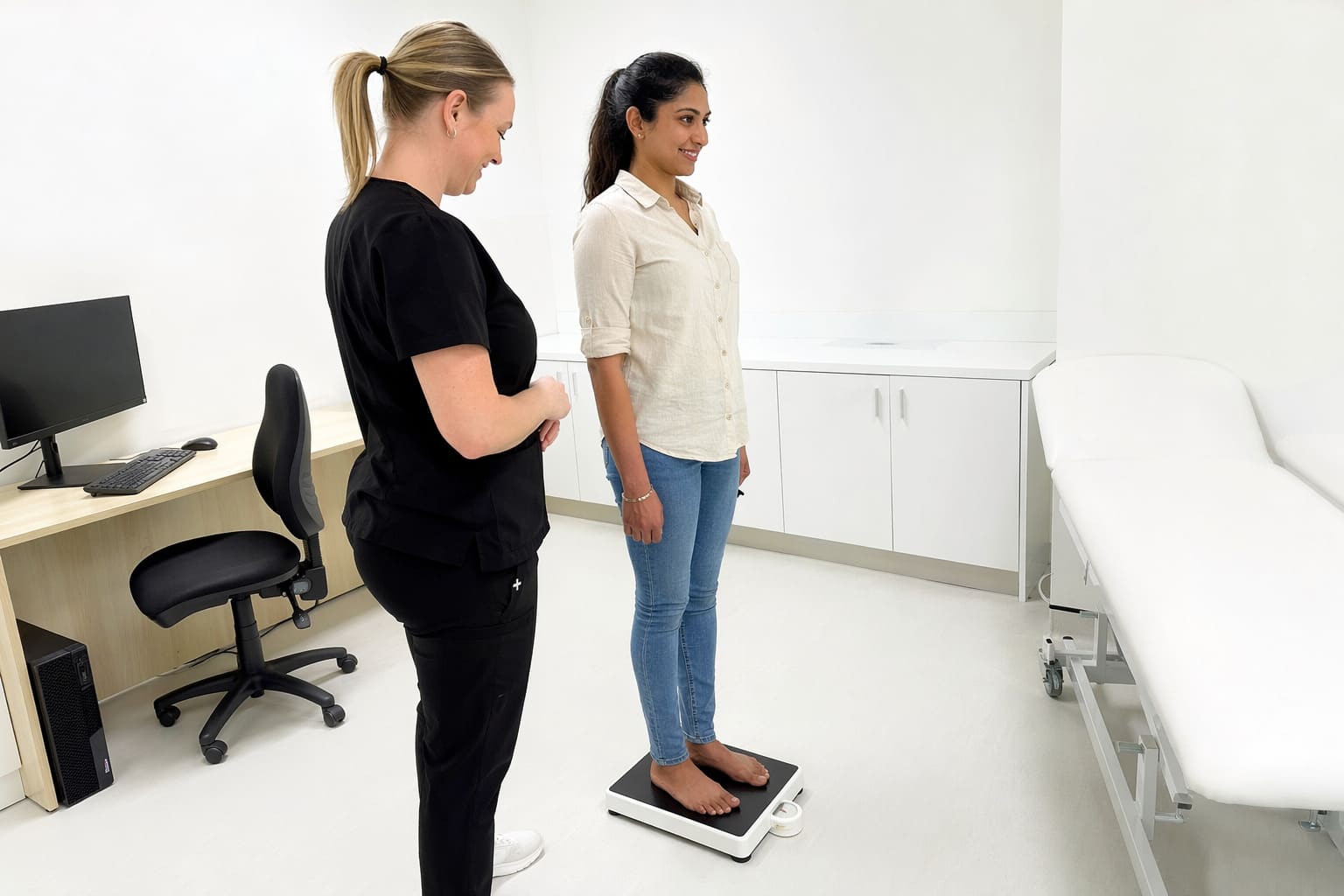
Women’s Weight Loss Follow-Up – Illustrative Image
A maintenance plan is written before the last injection, not after
“Eat well and keep moving” is not a plan. A plan says what you will watch, where you already know your routine tends to slip, and what you will do when it does.
NICE asks for regular feedback and monitoring for at least a year after weight-management medication ends. Agree the shape of that with your prescriber while you are still on treatment.
- Set your baseline. Record where you are before the last dose, including the clinical measures your prescriber has been tracking, not only your weight.
- Decide what you will monitor and how often. Enough to spot a direction of travel, infrequently enough that a single day’s fluctuation does not become a crisis. Your prescriber can help you pick a rhythm that suits you.
- Name your own pressure points. You already know the situations where structure disappears. Write them down while you are still on treatment, because they are much harder to think about clearly once appetite has returned.
- Agree your if-then responses. For example: if weight rises steadily across several weeks, or unplanned eating becomes frequent again, that triggers a review rather than a period of hoping it settles.
- Book the follow-up before you need it. A date in the diary is the difference between an early adjustment and a difficult conversation months later.
Sustainable eating habits, activity, routine and support from people around you all belong in the same plan. It is worth far more written down in advance than assembled after the weight has started to move.

Women’s Weight Loss Consultation – Illustrative Image
Weight is not the only thing worth watching
Two people can see the same number appear on the scales and need entirely different responses. One has reached a target weight and needs closer maintenance support. The other was taking tirzepatide as part of managing type 2 diabetes, and needs a medicines review.
The markers that moved during treatment can move back
What to monitor depends on your own risks and on why you were prescribed it. Relevant measures may include waist circumference, blood pressure, a lipid profile, which measures cholesterol and related blood fats, and HbA1c.
The SURMOUNT-4 analysis linked greater weight regain with greater loss of the earlier gains in waist circumference, blood pressure, non-HDL cholesterol, HbA1c, fasting glucose and insulin resistance. Follow-up that only looks at weight misses most of that.
When to review should be agreed in advance rather than judged in the moment. Pick a point with your prescriber that triggers a conversation, so you are not left deciding for yourself whether things have gone far enough to be worth mentioning.
If you take tirzepatide for type 2 diabetes, none of this replaces a diabetes-specific review of your medicines and glucose control. That needs to happen regardless.
You can see your GP about any of this, or book a private consultation directly.

Weight Loss Consultation – Illustrative Image
Questions we get asked about coming off Mounjaro
How quickly does appetite come back after the last dose?
Gradually, over the weeks after you stop, as the medicine clears from your system rather than all at once. Knowing it is coming is useful, because the change can otherwise feel like something has gone wrong with you rather than something predictable happening to your medication.
Does reaching my target weight mean I should stop?
Not automatically. Reaching a target opens the conversation rather than settling it, and for some people continuing at a maintenance level is the right answer. Your prescriber can weigh your progress, any side effects and your own preference.
Can I use leftover Mounjaro injections after I have stopped?
Not without a prescriber reviewing it first. Why you stopped determines whether restarting is appropriate at all, and that decision has to come before the injection does.
How long should follow-up continue after Mounjaro ends?
At least a year, according to NICE, with regular feedback and monitoring. How often, and what gets measured, depends on your history and the plan you have agreed.
What should I bring to a Mounjaro review?
Your current dose, any side effects, how your weight and appetite have behaved, and a list of your other medicines. Mention pregnancy plans, and any history of pancreatitis or type 2 diabetes, because each of those changes the decision.
This is general information, not medical advice.
Reviewed by Fang He, BSc MSc, Advanced Nurse Practitioner and Chief Executive Officer at Future Care Medical, member of the Faculty of Sexual and Reproductive Healthcare.