What does a normal testosterone level mean for your age?
There is no single UK figure. Adult male reference intervals sit broadly between about 8 and 30 nmol/L, with the upper end typically lower after fifty, and adult female intervals are far lower at around 0 to 1.9 nmol/L. Those are examples from one NHS laboratory rather than a national standard, because every laboratory sets its own.
So the range printed on your own report is the one that applies to you. Comparing your number against a chart you found online will frequently give you the wrong answer, since a different laboratory using a different assay can report the same blood sample against a different interval.

TRT Treatment – Illustrative Image
What Is In This Article
Your report’s range is the one that counts
UK reports use nmol/L, meaning nanomoles per litre. Laboratories may adopt the interval supplied by the assay manufacturer, or validate their own locally.
Oxford University Hospitals publishes these, which give a sense of the shape:
| Group | Example interval | What it shows |
|---|---|---|
| Males aged 19 to 49 | 8.3 to 30.2 nmol/L | The adult male band before laboratories typically adjust for age |
| Males over 49 | 7.7 to 24.8 nmol/L | Both ends drop, and the upper end drops more |
| Females over 18 | 0 to 1.9 nmol/L | An order of magnitude lower, and highly assay-dependent |
A reference interval tells you how your result compares with the population that laboratory measures. It does not tell you whether anything needs doing about it.
Being in range and being fine are different questions
This is where most online charts mislead people, because a laboratory interval and a clinical action threshold answer different questions.
The Society for Endocrinology and the Association for Clinical Biochemistry and Laboratory Medicine set out male action thresholds for investigating possible hypogonadism, and they do not map onto any one laboratory’s range.
Below 8 nmol/L. Two consecutive morning fasting results below this, alongside relevant symptoms, are likely to indicate hypogonadism.
Between 8 and 12 nmol/L. This band needs clinical correlation. A result of 10 nmol/L is not a diagnosis and not a dismissal. What decides it is the symptoms, how the sample was taken and what the related hormones show.
Above 12 nmol/L. This points away from hypogonadism. It does not mean your symptoms are imaginary, only that low testosterone is unlikely to be the explanation and something else is worth looking for.
The symptoms that make testosterone worth measuring in the first place include reduced libido, erectile difficulties, persistent fatigue, low mood, loss of muscle bulk and difficulty concentrating. None of them is specific to low testosterone on its own, which is exactly why the number and the symptoms have to be read together.

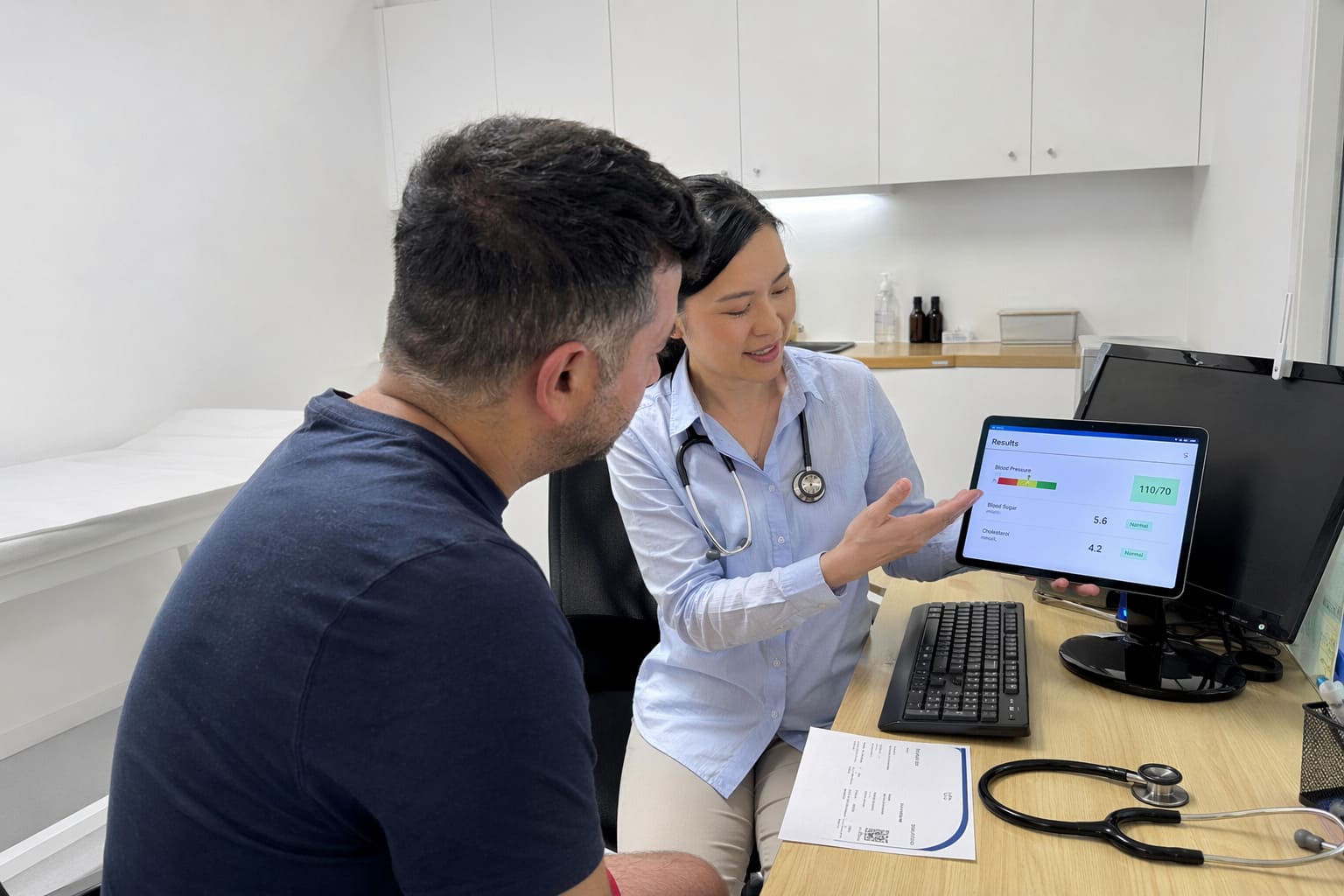
Referral Consultation Room – Illustrative Image
A badly timed sample tells you almost nothing
A morning fasting sample carries diagnostic weight. An afternoon test that comes back low often does not, and repeating the same mistake will not clarify it.
Samples taken after 11am, during acute illness, or after eating are not the recommended basis for diagnosing male hypogonadism. What makes a sample usable:
- Morning, and fasting. Testosterone follows a daily rhythm and is highest early. Eating lowers it.
- Not while you are unwell. Acute illness suppresses testosterone, so a sample taken during it measures the illness as much as anything else.
- Flag shift work or poor sleep. Restricted sleep lowers results, and shift patterns disrupt the daily rhythm the morning-sample rule depends on. Both need saying, because both change the interpretation.
- Repeat before concluding anything. Levels vary day to day, so a low result is normally confirmed with a second morning fasting sample before it means much.
We arrange planned hormonal assessments with the timing sorted in advance. Getting the first sample right is usually cheaper than getting the second one to explain the first.
Travel Vaccine Application Detail – Illustrative Image
When the number and the symptoms disagree
Total testosterone comes first
Total testosterone is the standard initial measurement, and interpreted properly it answers most questions. Where a result is confirmed low, luteinising hormone, known as LH, may be added to establish whether the cause sits in the testes or in the hormone signalling from the brain, which points at quite different things.
SHBG can change what the total means
Sex hormone-binding globulin, or SHBG, is the protein that binds testosterone in the blood. When SHBG is unusually high or low, the total figure can be misleading, because it counts bound and unbound testosterone together.
Calculated free testosterone estimates the portion actually available to the body. It earns its place in two situations: when total testosterone sits near a threshold, and when SHBG falls outside its own reference interval. The UK professional position is to use the calculated version rather than the directly measured free testosterone assays that are routinely available.
So what should you actually ask?
Not whether your number is normal for your age. Ask three things instead: was the sample taken under conditions that make it interpretable, has a low result been confirmed on a second morning sample, and does the result fit what is actually happening to you.
For female results, the same caution applies with more force. Intervals are lower, more assay-dependent, and there are no established national clinical decision limits for female reproductive conditions. A single figure interpreted against a chart is worth very little without the life stage and the reason for testing alongside it.
An age chart is where the question starts, not where it gets answered.
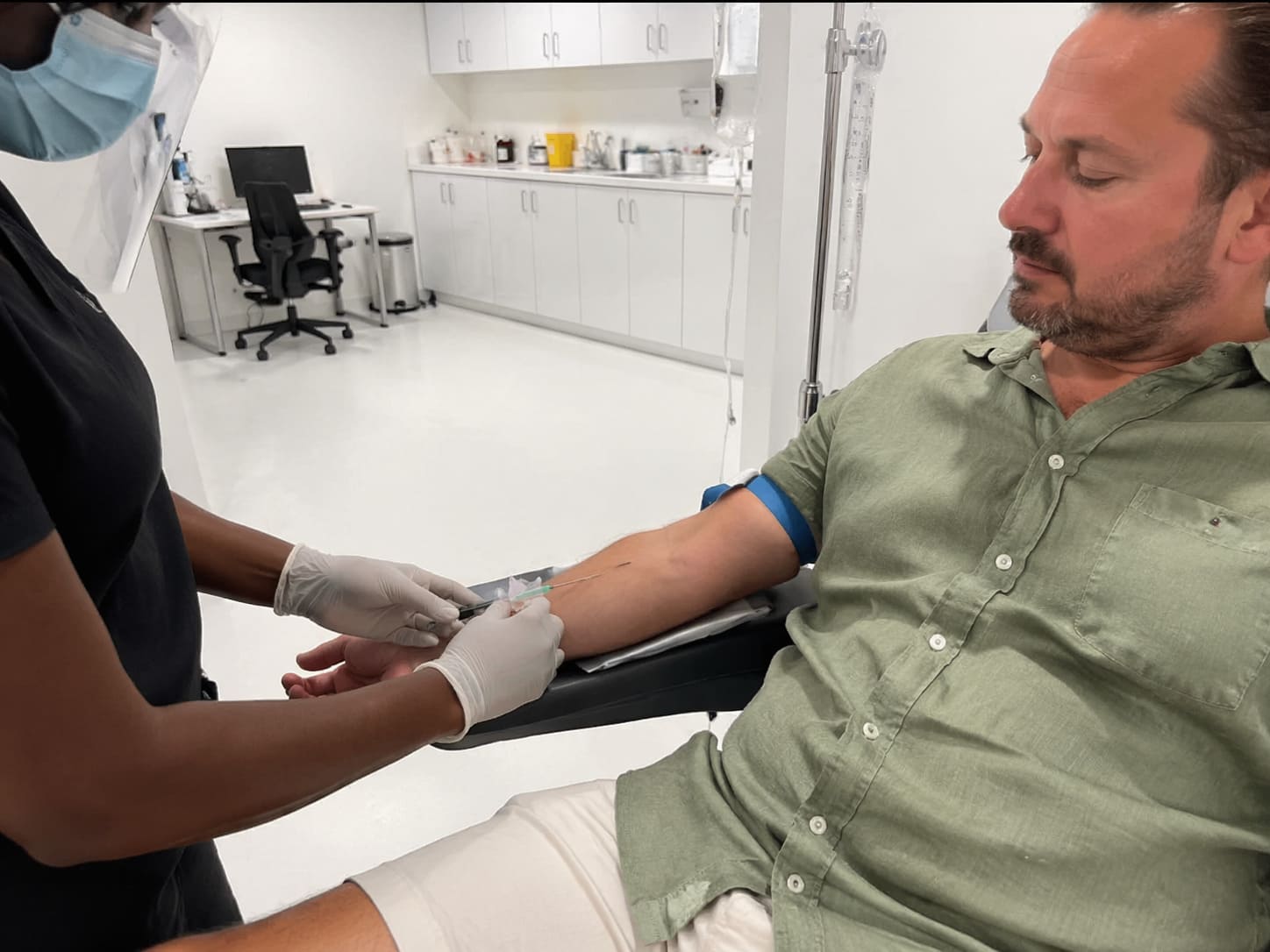
IV Cannulation in Progress – Illustrative Image
Questions we get asked about testosterone blood tests
Can I compare testosterone results from two different laboratories?
Not reliably. Different assays produce different values from the same blood, and each laboratory reports against its own interval. Compare each result with the range printed on that report, and treat any difference between the two as a question for a clinician rather than a trend.
What does nmol/L mean on my result?
Nanomoles per litre, the unit UK laboratories use for testosterone. American sources often use ng/dL instead, which is why numbers found online can look wildly different from yours.
Can a female testosterone result diagnose menopause?
No. Menopause is assessed from symptoms, age and life stage, and a testosterone figure adds very little to that. It is measured in women for other reasons entirely.
Who can assess a borderline testosterone result?
Your GP can review the symptoms, arrange repeat testing and add related hormones where useful. You can also book a private GP consultation directly if you would rather have it looked at sooner.
Why has SHBG been included on my blood test?
Because it changes how the total should be read. If SHBG is high or low, your total testosterone can look better or worse than the amount your body can actually use, and calculating free testosterone corrects for it.
This is general information, not medical advice.
Reviewed by Fang He, BSc MSc, Advanced Nurse Practitioner and Chief Executive Officer at Future Care Medical, member of the Faculty of Sexual and Reproductive Healthcare.